
INTERVIEW | The Lawyer–Business Relationship Is a Strategic Partnership
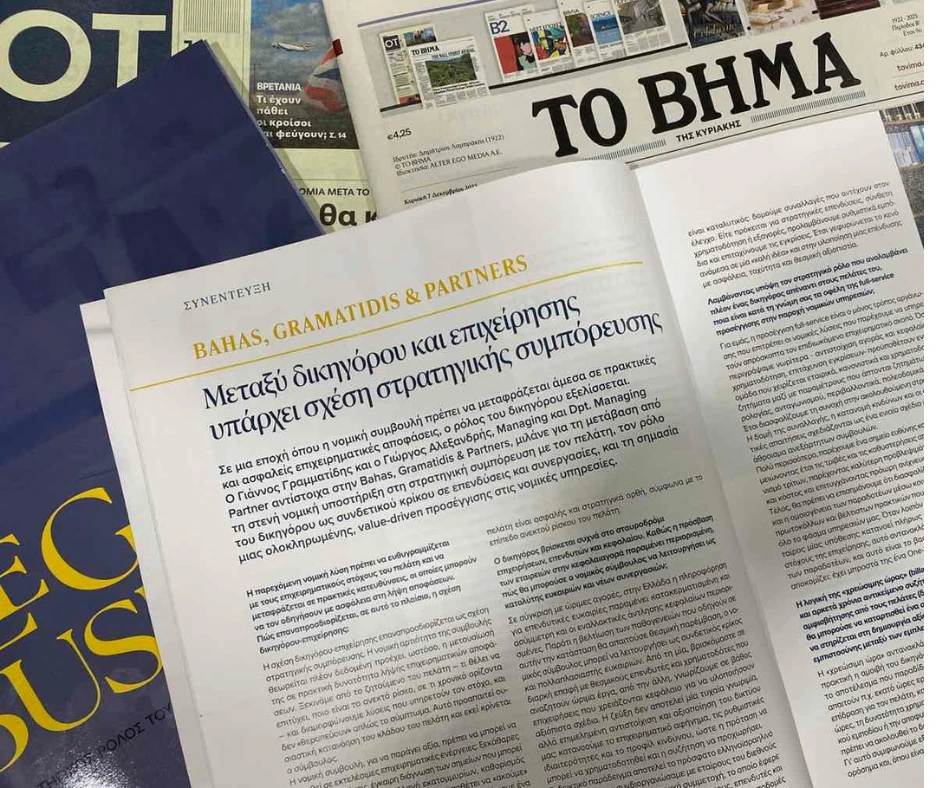
INTERVIEW | Bahas, Gramatidis & Partners
The Lawyer–Business Relationship Is a Strategic Partnership
The Legal Side of Business (special edition) | Boussias Media, in collaboration with The Lawyer Magazine and TO VIMA newspaper.
In a market where legal advice must translate quickly into safe, workable business decisions, the role of the lawyer is changing. Yanos Gramatidis (Managing Partner) and George Alexandris (Deputy Managing Partner) of Bahas, Gramatidis & Partners discuss the shift from narrow legal support to strategic partnership, the lawyer’s role as a bridge between businesses and capital, and why a full-service, value-driven approach is increasingly essential.
Legal solutions must align with business objectives and become practical guidance that enables safe decision-making. How does this reshape the lawyer–business relationship?
It reshapes it into a strategic partnership. Technical legal correctness is assumed. The differentiator is whether advice can be converted into decision-ready direction.
We begin with the client’s objective: what they want to achieve, the level of risk they are prepared to accept, and the timeframe that matters. From there, we design solutions that serve the goal, rather than merely “treating the symptom”. That requires a real understanding of the client’s sector and operating reality. This is where advisers are separated from technicians.
Legal advice creates value only when it can be translated into executable business actions: clear options, early identification of issues that can derail a multi-million-euro transaction, and a recommendation that is both legally sound and commercially workable. It starts with listening. We recently ran a “reverse seminar”, where a client briefed our teams on the pressures and constraints of their industry. The outcome was sharper diagnosis of what truly mattered and a faster move from analysis to implementation.
In practice, the lawyer becomes a strategic companion: aligning legal and commercial risk, reducing uncertainty, and ensuring the client’s decision is not only safe, but strategically right for their risk tolerance.
Lawyers often sit at the intersection of businesses, investors and capital. With limited access to capital markets, how can legal counsel act as a catalyst for opportunities and new partnerships?
Compared to more mature markets, Greece still faces fragmented information about investment opportunities and a relatively narrow set of funding alternatives. While addressing the root causes requires institutional change, legal counsel can nonetheless act as a connector and multiplier of opportunity.
We are continuously in dialogue with institutional investors and financiers looking for investable, mature projects. At the same time, we work closely with businesses that need capital to execute credible growth plans. Connecting these sides is not a casual introduction. It is a curated match built on understanding the business narrative, the regulatory constraints, and the risk profile, so that the proposition is financeable and the conversation can progress with momentum.
A recent example is the Greek–Israeli B2B forum we co-organised with partners from our international network, with strong institutional participation. It brought government representatives, investors and Greek businesses to the same table, across sectors including energy, infrastructure and tourism. Several discussions have already progressed toward sizeable investment opportunities.
From there, the lawyer’s role becomes decisive. We structure transactions that stand up to scrutiny. Whether the matter is a strategic investment, complex financing or an acquisition, we anticipate regulatory obstacles and help accelerate approvals. This is how you bridge the gap between a “good idea” and an investment that is implemented with speed, safety and institutional credibility.
As lawyers take on a more strategic role for clients, what are the advantages of a full-service approach?
For us, full-service is not a slogan. It is the only structure that allows legal solutions to serve the business objective without friction.
Everything described above, connecting capital to opportunity, securing financing, accelerating approvals, requires a single team that can handle corporate, regulatory and financing issues alongside tax, competition, environmental and planning considerations, and more. That is how you maintain strategic coherence.
Transaction structure, risk allocation and licensing requirements must be designed as one integrated plan, not as a collection of disconnected opinions.
Just as importantly, full-service provides one point of accountability. That reduces delays and friction caused by coordinating multiple third parties, improves predictability on time and cost, and enables earlier risk detection.
Finally, consistent quality depends on consistent methodology. Common internal protocols and best practices across all service lines create stronger, more uniform deliverables. When the coordinating partner fully understands the client’s strategic objectives, that clarity carries through every workstream. The client experiences what it should be: a true one-stop shop.
The billable hour has been debated for years and increasingly challenged by clients. How can fees be structured around value and trust?
Billable time measures effort, not value. Modern legal fees should reflect the outcome delivered.
Some matters require extensive work with limited commercial impact. Others, handled in a short window, determine whether financing is secured, a regulatory barrier is removed, or substantial cost is avoided. Pricing should follow the second: the business stakes.
That is why we agree upfront on the objective, deliverables and milestones and, where feasible, structure fees around the value created. In parallel, we invest in processes, templates and technology so that we can leverage experience and shorten delivery cycles without compromising quality.
Clients should not pay for internal inefficiency. They should pay for results that move their business forward.
Trust is built through transparency and predictability. That is how remuneration becomes linked to business value, rather than the stopwatch.
Business operates without borders. How do you build a cross-border support network that ensures reliability, speed and genuine access to international markets?
Cross-border transactions demand a network of professionals who share principles, apply consistent standards and work with aligned best practices. Building that in real life is difficult.
We are privileged to have been, since 2000, the exclusive member for Greece of the World Law Group, a global network with 400+ offices in 85+ countries. This gives us the ability to support our clients’ international activity worldwide, while also supporting inbound international business in Greece with the same discipline and quality.
We maintain that consistency through regular conferences and seminars focused on best practices, training programmes, joint initiatives that strengthen relationships and market access, and continued alignment of standards and procedures.
For clients, this translates into what matters: reliable execution, speed where it counts, and meaningful access to international markets.
You may read the interview in Greek at the viewer below:
The interview was originally published on December 7, 2025, in Boussias Media’s special edition “The Legal Side of Business”, produced in collaboration with The Lawyer Magazine and TO VIMA newspaper.